Tyre
Tyre DPP Requirements
The Digital Product Passport for tyres: durable marking, material declaration, wear and recycling data. A guide for tyre manufacturers.
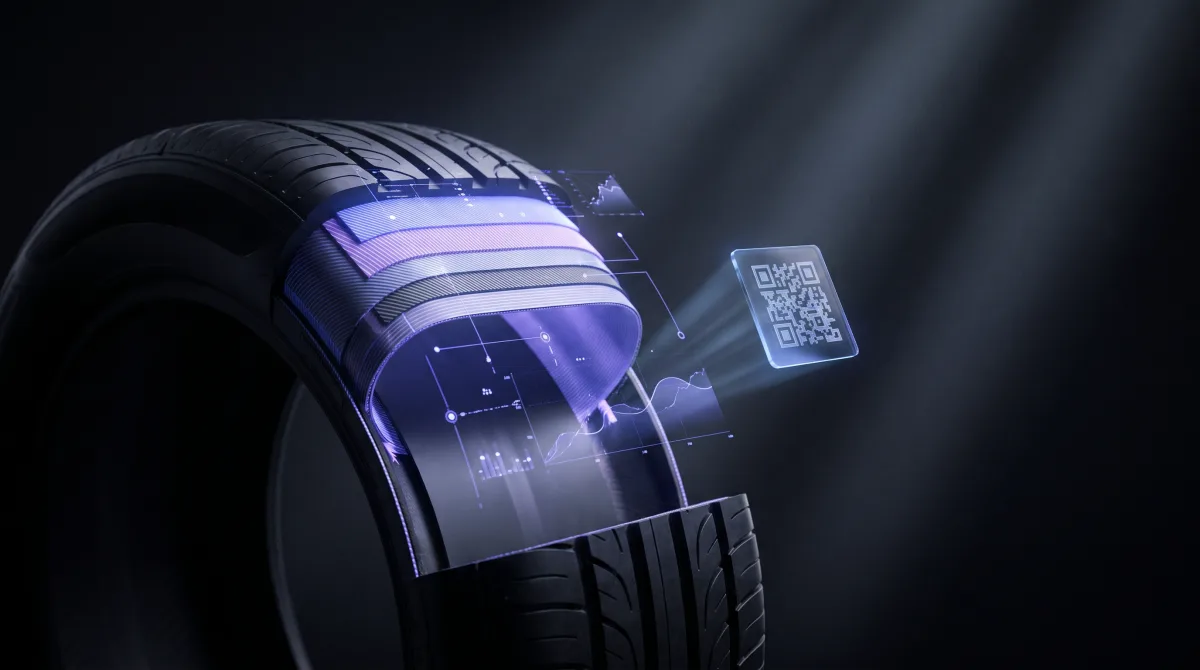
Tyres pose an interesting challenge for the Digital Product Passport: on a product exposed to road, heat and wear for years, how does the passport link stay readable? This article covers the data and carrier requirements of a tyre DPP.
Why do tyres matter?
Tyres are high-volume products, dense in rubber and carbon black, with critical end-of-life management. Because of microplastic emissions and recycling difficulties, they appear among ESPR's priority product groups.
Typical data in the passport
- Identity: manufacturer, size, type, production date (DOT)
- Material composition: rubber types, fillers, recycled content
- Performance: rolling resistance, wet grip, noise (aligned with the existing tyre label)
- Durability: expected life, wear indicators
- Recycling: end-of-life recovery and disposal information (circularity)
The marking challenge
For tyres, the physical durability of the data carrier is decisive. A printed QR can wear off, so a moulded QR or Data Matrix on the sidewall is preferred. Some makers embed an RFID chip during vulcanisation for contactless reading.
Whatever the carrier, the GS1 Digital Link URL it encodes must keep working throughout the tyre's life — a concrete requirement of the EN 18220 persistence principle.
For exporters
Tyre makers are already familiar with EU tyre-labelling rules; the DPP extends and digitises them. Moving your existing test and performance data into a structured passport is far easier than starting from scratch. Begin by mapping your existing data with the data-collection checklist.
Frequently asked questions
Does it replace the tyre label?
No. The EU tyre labelling regime is separate; the passport presents data digitally and machine-readably.
What is needed for rubber origin?
EUDR can require origin evidence at geolocation level. See EUDR.
How is retreading handled?
Retreading is a lifecycle event recorded in the traceability layer. See event-based traceability with EPCIS 2.0.