Chemicals
The Detergents Regulation: Digital Label and the DPP
The Detergents Regulation revision brings a digital label and a product passport concept: what stays on the pack, what moves to the QR and how to build one code
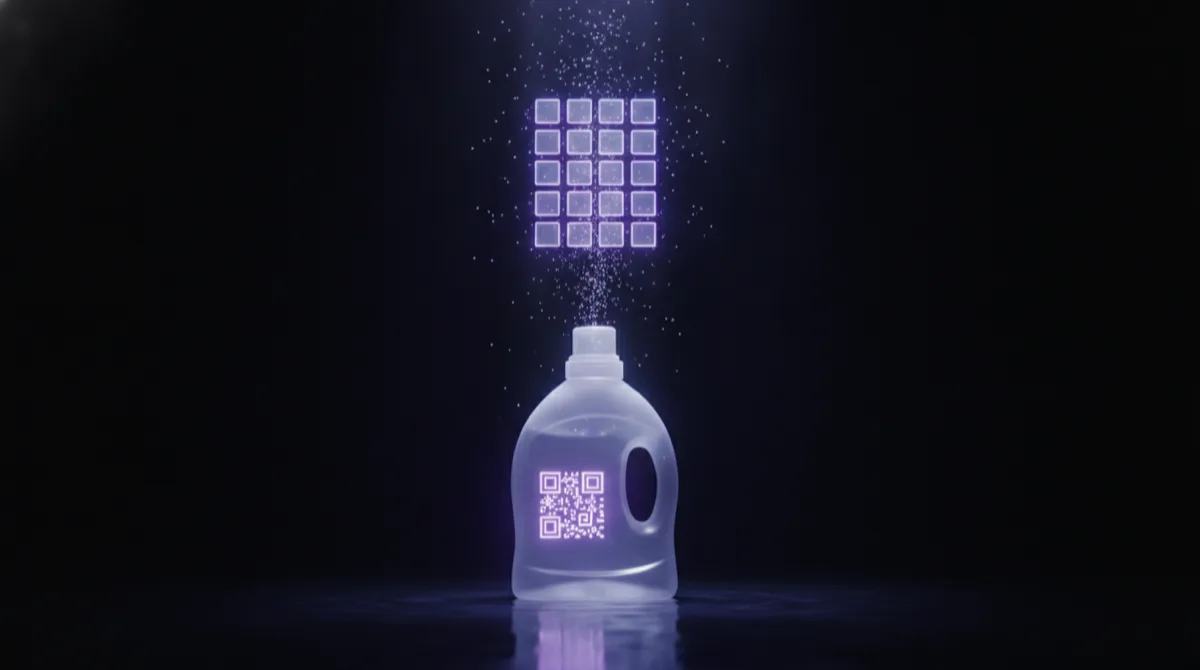
Regulation (EC) 648/2004 on detergents has governed consumer detergents' ingredient label, surfactant biodegradability and ingredient datasheet for over twenty years. The Commission's April 2023 revision proposal has been negotiated by Parliament and Council; the final text and its application dates will follow publication in the Official Journal. Its backbone is digitalisation: part of the ingredient information moves to a digital label via a data carrier, and detergents get a product passport concept aligned with ESPR.
Detergents occupy a particular spot in the Digital Product Passport debate: not an ESPR priority group, yet their own regulation borrows ESPR's passport concept.
What the current regulation requires
648/2004 sets up two layers of information, on the pack and off it:
- On the pack: ingredient groups by weight band (surfactants, phosphates, bleaching agents and the like); enzymes, preservatives, disinfectants, optical brighteners and perfumes by name; allergenic fragrances individually above a threshold; dosage instructions for laundry detergents.
- Off the pack: an ingredient datasheet for medical personnel and the full ingredient list online for consumers.
So an online ingredient list is nothing new for detergents; the revision ties it to a data carrier on the pack. For the substance declaration's source, see DPP for chemicals, REACH and SCIP.
What the revision brings
The headings of the agreed text follow. Because the detail depends on the published regulation, we give no dates:
- Digital label: certain information may be provided via a data carrier on the pack.
- Simplified dosage information: a simpler dosage table for laundry detergents.
- Detergents containing micro-organisms: explicit safety requirements for the first time.
- Refill sales: an information duty for detergent sold at refill points.
- Product passport: conformity documents and technical information provided through a passport aligned with ESPR.
What stays on the pack, what goes digital
| Information | On the pack | On the digital label |
|---|---|---|
| Dosage instructions and number of washes | Stays | May be repeated |
| CLP hazard elements (pictograms, signal word, H/P) | Stays | May be repeated |
| Safe-use warnings | Stays | May be repeated |
| Full ingredient list (in order) | May move | Primary place |
| Detail on allergenic fragrances and preservatives | May move | Primary place |
| Detail on ingredient groups, enzyme information | May move | Primary place |
| Declaration of conformity and technical information | None | In the passport, authority tier |
The principle is simple: what the consumer needs at purchase and in use stays on the pack; research and verification information goes digital, the design logic of the ESPR passport's public tier. See what a consumer scanning the QR should see.
One QR: CLP, detergent information and the passport
A detergent pack can serve three regimes: the CLP digital label (complementing hazard information), the detergent digital label (ingredient list) and the product passport. Three printed codes tire consumer and inspector alike. The right architecture is one QR on GS1 Digital Link, routed by link type: safety information, ingredient list, passport. For the CLP side, see the CLP revision and digital labelling.
The packaging itself falls under PPWR: recyclability grade, recycled content and the harmonised sorting label; the same QR can carry that too. See PPWR-compliant packaging labelling.
The retail and marketplace dimension
Detergent is a retail product, and retail chains already ask suppliers for ingredient and sustainability data ahead of any passport. Online, the label information must be visible before purchase, so the product page should draw on the same source as the digital label. See what retailers ask of suppliers and DPP in e-commerce and marketplaces.
Preparation for Turkish detergent exporters
- Keep the ingredient list as structured data per SKU; generate pack text and web page from one source.
- Tie the CLP classification, UFI and SDS to the same product record.
- Set up the single-QR and resolver architecture; manage a content version per market language.
- Prepare the declaration of conformity and the technical file for the passport's authority tier.
- Track publication and application dates; once fixed, run the packaging revision plan.
For the overall framework, see the DPP guide.
Frequently asked questions
When will the Detergents Regulation revision apply?
The final text has not yet been published in the Official Journal; application dates will depend on the transition periods that follow publication, so the published text will give the exact date.
Is the ingredient list disappearing from detergent packaging?
The full list may move to the digital label; dosage instructions, safety warnings and CLP hazard elements stay on the pack. Which element goes where depends on the final text.
Is the detergent passport the same as the ESPR Digital Product Passport?
Not the same, but compatible: the detergent passport is the Detergents Regulation's instrument and builds on ESPR's passport rules. One QR and one data infrastructure can serve both.