Data Carriers
Data Matrix and Direct Part Marking (DPM)
What a Data Matrix code is, how it differs from a QR code, and how direct part marking gives metal, glass and plastic parts a permanent identity.
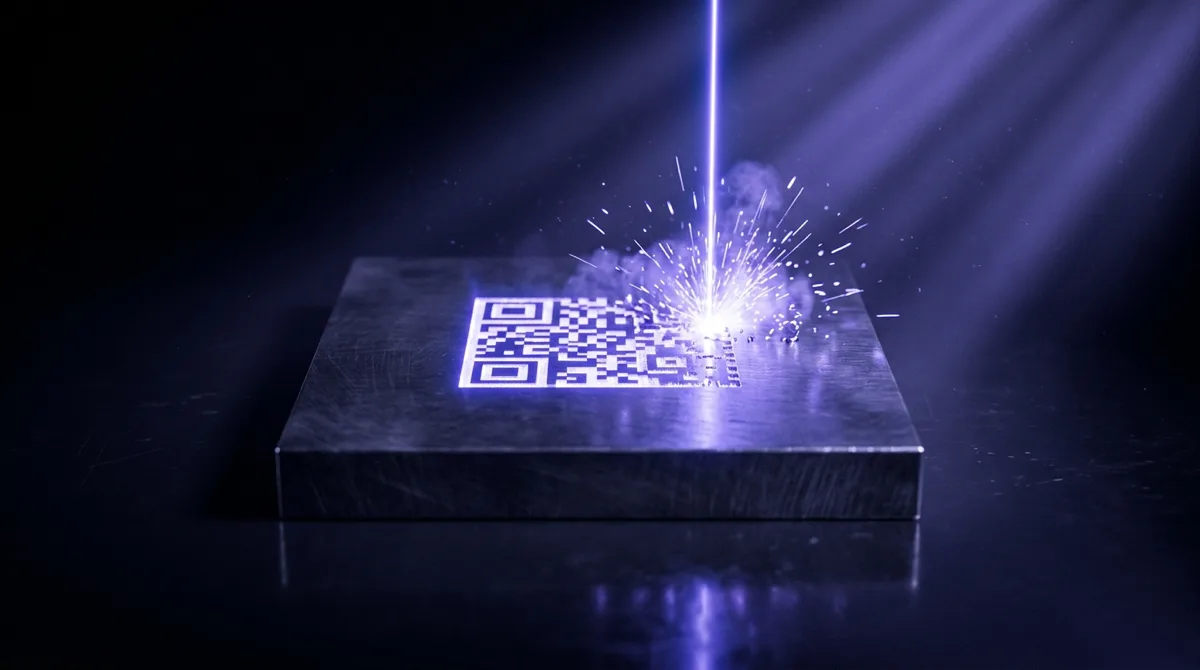
On some products a label is not an option: heat, oil, abrasion or chemical exposure destroys it. In those cases the code goes into the part itself — direct part marking (DPM) — and the preferred symbol is usually Data Matrix.
Data Matrix versus QR
| Property | QR | Data Matrix |
|---|---|---|
| Practical minimum size | ~12 mm | ~5 mm |
| Phone camera support | Excellent | Good (app-dependent) |
| Damage tolerance | Good | Very good |
| Industrial adoption | Medium | High |
| Consumer recognition | High | Low |
The rule of thumb: QR if a consumer reads it, Data Matrix if a machine does.
DPM methods
- Laser marking: the most common on metal and plastic; fast and permanent.
- Dot peen: for rough metal surfaces and castings.
- Chemical etching: for thin stainless surfaces, with low heat impact.
- Inkjet: cheap but the least durable.
The choice depends on material, surface roughness and product lifetime.
Where it is used
- Iron, steel and aluminium: heat or billet-level traceability. See DPP for iron and steel and DPP for aluminium.
- Electronic components: millimetre-scale space on a board.
- Automotive parts: lifetime traceability and recalls. See DPP in automotive.
- Machinery and equipment: permanent identity beside the nameplate. See IEC 61406.
Readability: the hard part of DPM
DPM codes differ from printed ones: contrast comes from surface geometry, not ink. As a result:
- Dedicated readers with angled illumination may be needed.
- Surface treatments such as paint or coating can hide the code — sequence the marking step carefully.
- Verification uses different methods from standard print quality grading.
The consumer access problem
EN 18220 requires at least one carrier to be free and smartphone-readable. A small Data Matrix does not guarantee that on every device. The usual answer is dual carriers: a DPM Data Matrix on the part and a QR on the packaging or nameplate. See DPP QR codes.
Frequently asked questions
Can a Data Matrix carry a GS1 Digital Link?
Yes. Symbology and data content are independent; the same URI can be encoded in Data Matrix. See GS1 Digital Link.
What does DPM cost?
Laser marking requires capital investment, but unit cost is very low with no consumables. At volume it can be cheaper than labels.
Does reworking a part destroy the code?
Machining or surface treatment can remove it. Place the marking step as late in the process as possible.