Battery
Second-Life Batteries and Passport Continuity
Passport continuity for second-life batteries: Article 73 repurposing and remanufacturing, a new passport linked to the original, SoH and who is responsible.
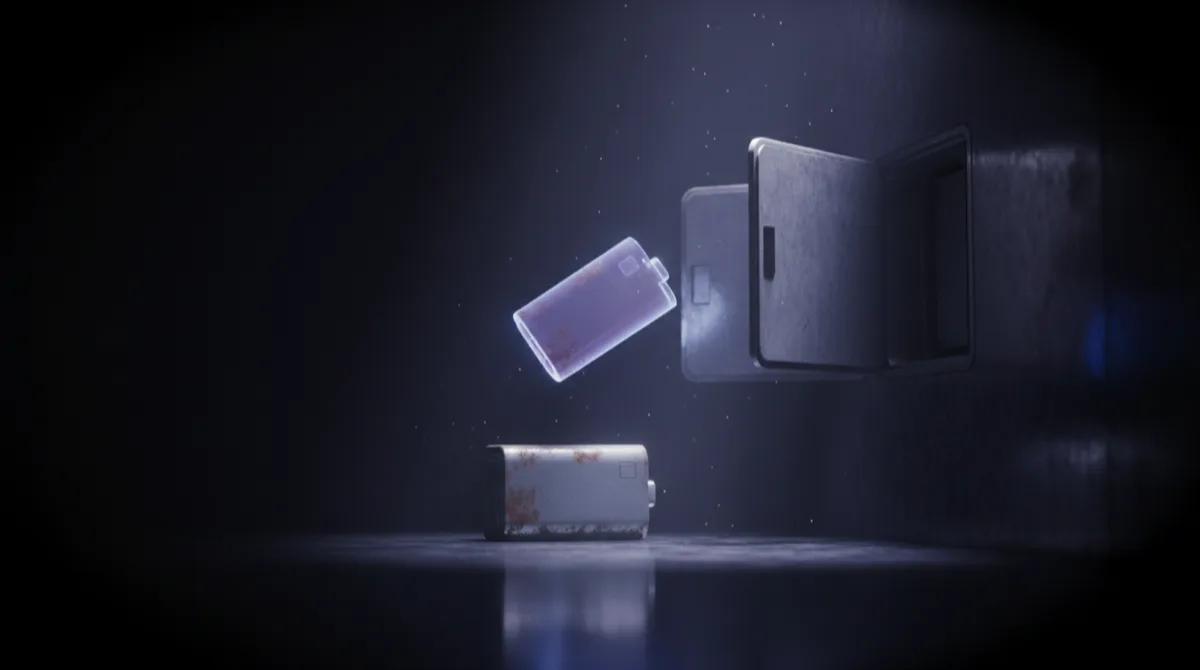
When an EV battery falls short for the vehicle, it is not finished; it can work for years in stationary energy storage. The EU Battery Regulation treats this second life not as an exception but as a defined process: separate definitions and obligations for re-use, repurposing and remanufacturing, and a separate rule for the Digital Product Passport.
This article explains what happens to the passport when a battery enters a second life and who carries it afterwards. How dynamic data is collected is covered in battery state of health and dynamic data; here we look at how that data drives the decision and the handover.
Four operations, different outcomes
| Operation | What is done | Effect on the passport |
|---|---|---|
| Preparation for re-use | A waste battery is checked and, if needed, repaired for the same purpose | New passport, linked to the original |
| Repurposing | The battery is used for a purpose other than its design purpose (an EV pack in stationary storage) | New passport, linked to the original; the new category's rules |
| Remanufacturing | All cells and modules are dismantled and assessed, capacity restored to the level in the definition, same purpose | New passport, linked to the original |
| Repair | Limited intervention; the battery remains the same product | Same passport, new version |
Article 73: new product, new responsible party
Article 73 governs repurposing and remanufacturing of industrial and EV batteries. The core principle: the battery that comes out is a new product placed on the market. It must meet its new category's requirements; an EV pack moved into stationary storage now falls under the rules for industrial batteries. The operator performing the work and placing the battery on the market counts as the manufacturer: conformity assessment, technical documentation, labelling and the passport are its responsibility.
This follows from the logic of economic operators and their responsibilities: responsibility concentrates on whoever places the product on the market. A battery that has become waste enters this route only through a preparation step under waste law; there is no direct path from scrap to second life.
Handing over the passport: a link, not a copy
Article 77 sets a clear rule for a battery entering a second life: it receives a new passport linked to the original passport (or passports, if it was built from several batteries), and the passport obligations pass to the new operator. Three design consequences follow:
- The original passport is neither deleted nor overwritten; it stays accessible as read-only.
- The new passport carries an explicit link to the original's identifier; a remanufactured pack may link to several old packs.
- Although the battery's physical identity does not change, the placing on the market is new: new QR, new identifier, new responsible party.
The passport lifecycle article covers which event closes a passport (recycling) and which hands it over; how identities are linked in a pack assembled from modules of mixed origin is in cell, module and pack granularity.
SoH: the input to the decision
Second life is built on data, not on haggling. The buyer wants three answers: how much capacity is left, how was it used, is it safe? They sit in the passport's legitimate-interest tier: SoH history, cycle count, temperature exposure, fault and service records. The regulation also requires that the state-of-health and expected-lifetime data in the BMS be accessible to whoever has legally acquired the battery (Article 14); the passport is the structured form of that access.
Access matters here: the buyer wants to assess the battery before buying it. Access roles in the battery passport unpacks the legitimate-interest concept; for the general model see access rights and roles.
A flow for the energy-storage integrator
A practical sequence for a stationary-storage integrator buying used EV packs:
- Scan the pack's QR and verify the original passport and identifier; a pack without a passport is a pack without papers.
- Pull the SoH history and event records through legitimate-interest access; set your acceptance threshold in writing.
- Test the pack yourself and write the results into your own record; do not alter the original passport.
- Determine the new product's category and meet its requirements; for scope see which batteries, who is obligated.
- Create the new passport linked to the original and print the new QR.
- In the contract, secure the data handover from the seller and the first operator's commitment to keep the original passport accessible.
This is the battery-specific version of the general model in DPP in resale and second-hand; see the battery passport guide for the full framework.
Frequently asked questions
Who creates the passport for a second-life battery?
The operator that repurposes the battery and places it on the market; the regulation treats it as the manufacturer. The original passport remains the source, but the new record belongs to the new operator.
How long must the original battery passport stay accessible?
At least for the life of the new battery, since the new passport links to it. A passport ends when the battery is recycled; that is why linked records are kept as a chain.
Which rules apply to a repurposed EV battery?
Those of the category of its new use. An EV pack moved into stationary storage counts as an industrial battery, and that category's requirements apply.